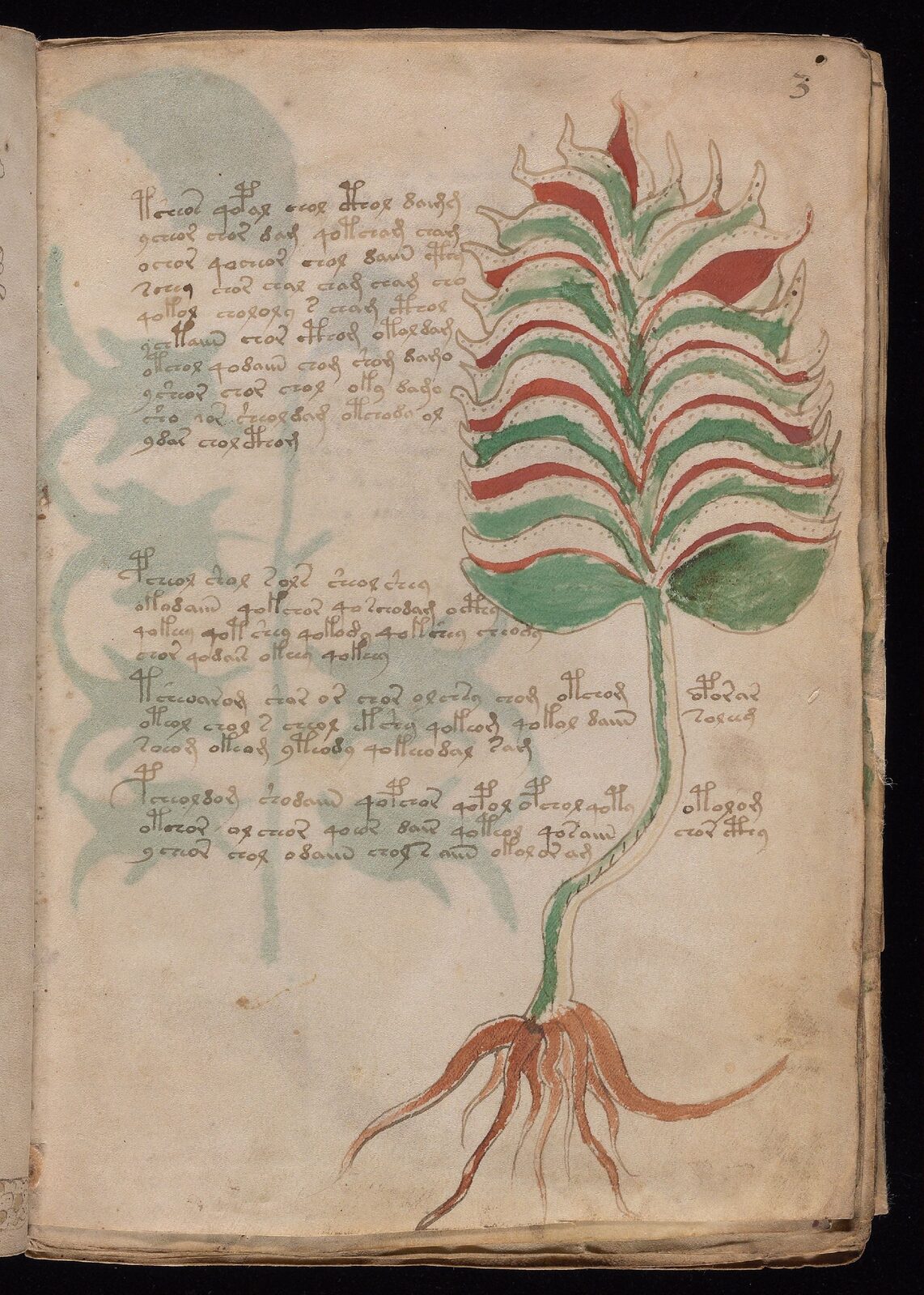
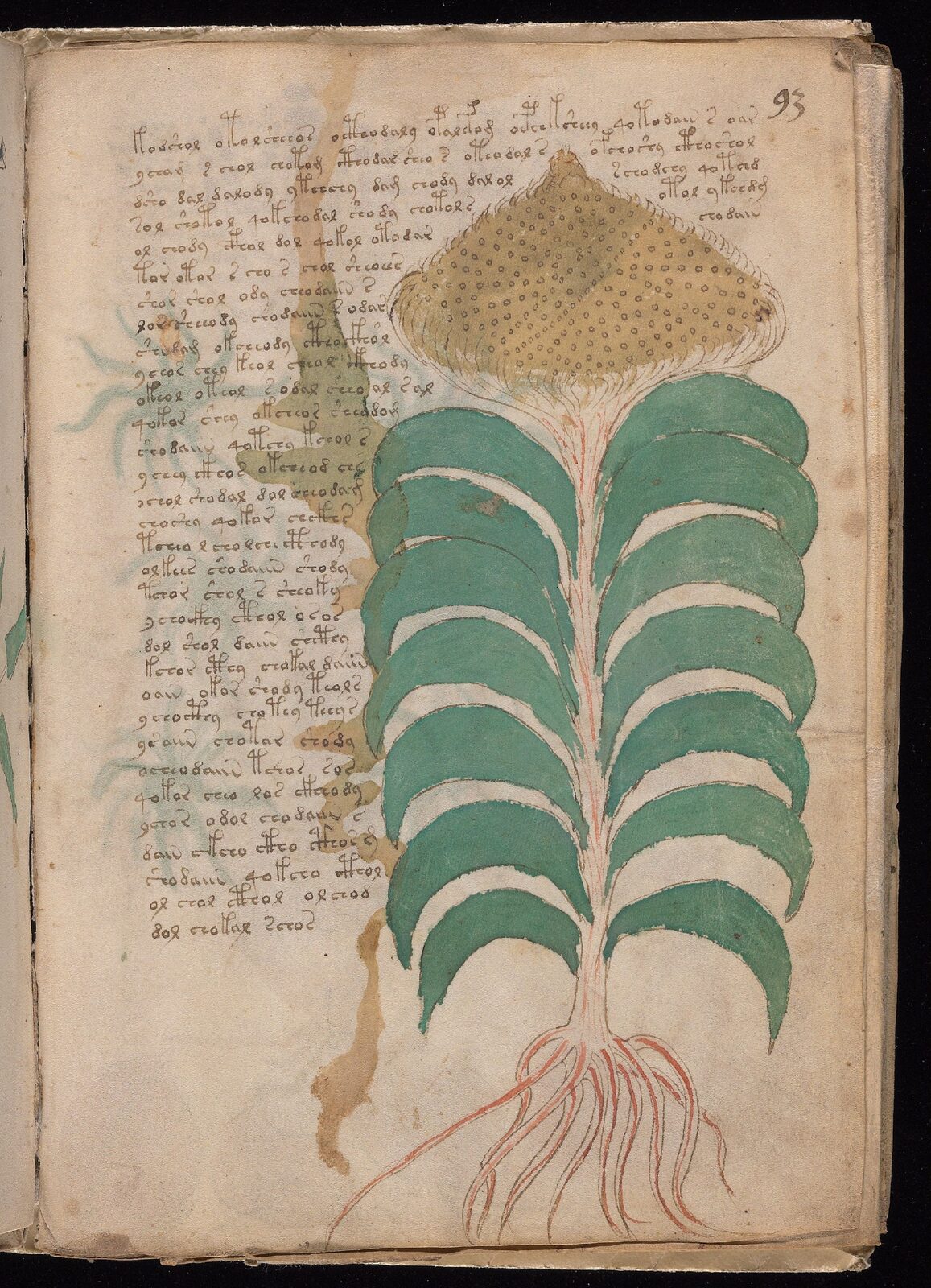
Pages dominated by large plant drawings, each typically with accompanying text. Most herbal pages follow this single-plant layout, one drawing to a page.
A parchment codex, early fifteenth century, illustrated throughout
Beinecke MS 408 is a parchment codex of the early fifteenth century, illustrated throughout and written in an unidentified script. It is incomplete, leaves are missing, and several surviving leaves fold out. The drawings are executed in ink with added colour washes. This page records the object as object: its identification, material state, the sections scholars conventionally divide it into, and its digitization state. It records what can be said about the codex without depending on a reading of the text.
Identification, material description, and access state. This is the codex before any interpretation: shelfmark first, then material, then content.
| Shelfmark | MS 408 |
|---|---|
| Repository | Beinecke Rare Book & Manuscript Library, Yale University, New Haven. |
| Common name | The Voynich Manuscript. |
| Support | Parchment (vellum). Drawings in ink with added colour washes. |
| Radiocarbon date | 1404–1438 (95% confidence), early fifteenth century. The date is of the parchment support. |
| Script | “Voynichese”, an unidentified, undeciphered script. The language of the text is undetermined. |
| Scribal hands | Two principal text styles are distinguished in the scholarly literature (conventionally “Currier A” and “Currier B”); multiple-hand attributions have also been proposed. |
| Extent | 102 parchment folios plus one paper leaf, with folding leaves. Beinecke catalogue, physical description. Digital image counts are separate from physical leaf counts. |
| Digitization | Fully digitized at source by the Beinecke Library; high-resolution images are publicly available through Yale’s digital collections. |
| Preferred citation | New Haven, Beinecke Rare Book & Manuscript Library, Yale University, MS 408. |
The manuscript is conventionally divided into sections by the dominant illustration type. These groupings are descriptive conventions used by scholars; the divisions are not labelled in the manuscript itself, and the boundaries between them are read off the illustrations, not stated by the codex. One folio is shown for each.
Pages dominated by large plant drawings, each typically with accompanying text. Most herbal pages follow this single-plant layout, one drawing to a page.
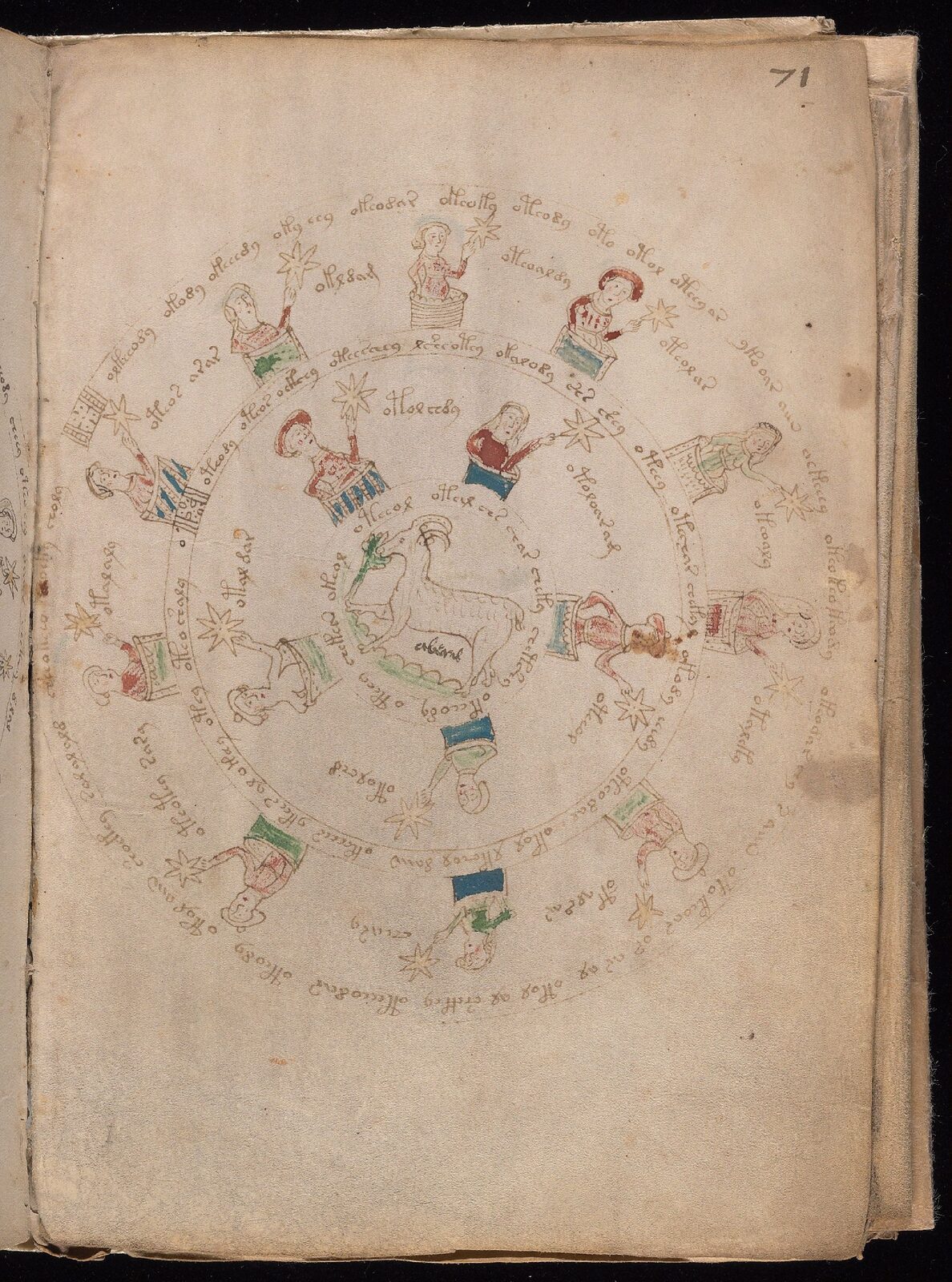
Circular diagrams, star-like figures, and a sequence of zodiac emblems with surrounding human figures. The zodiac sequence runs emblem by emblem, each ringed by small figures.
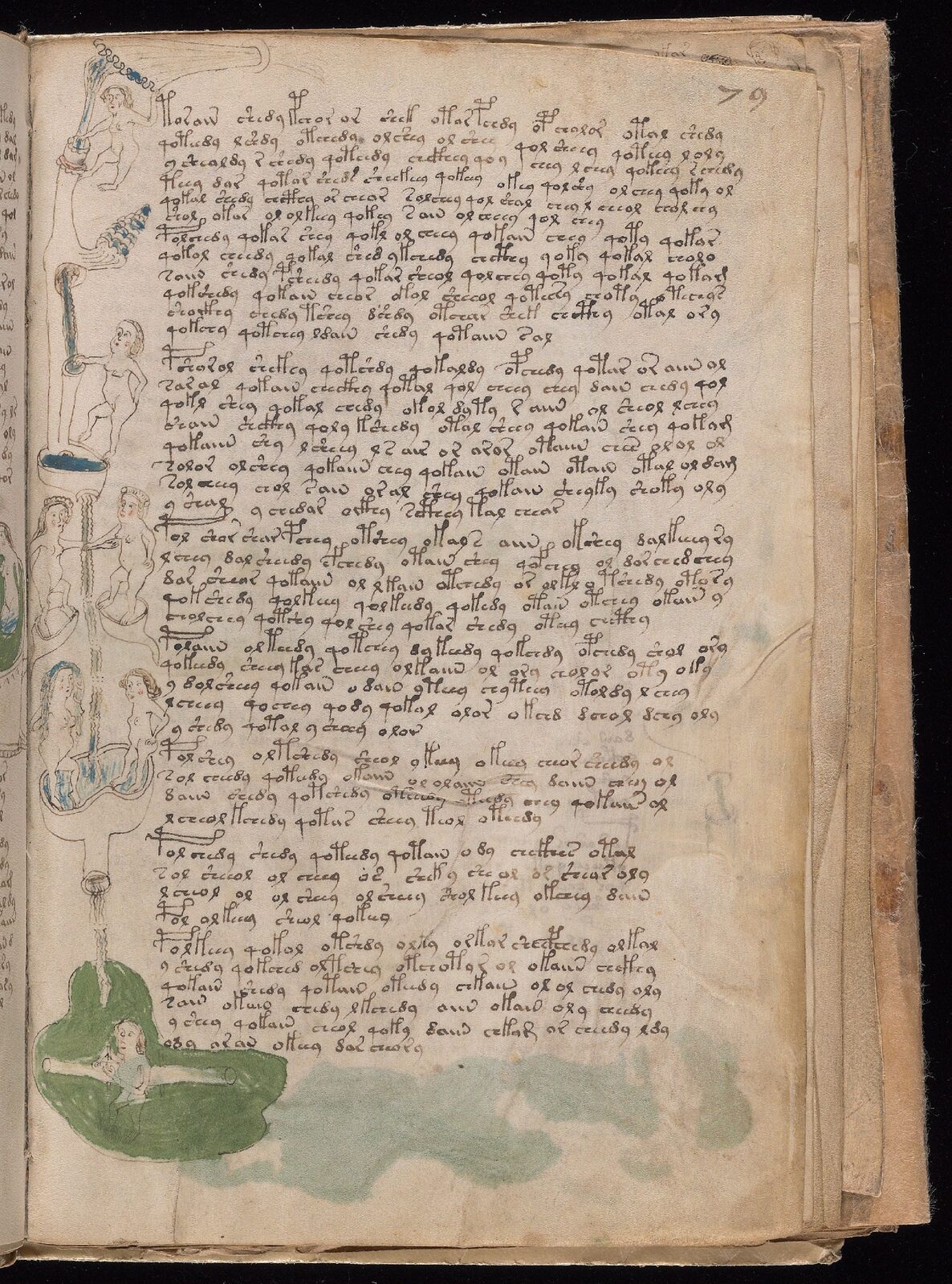
Drawings of human figures in pools, basins, and connected conduits. The figures recur across the section, linked by drawn channels of water.
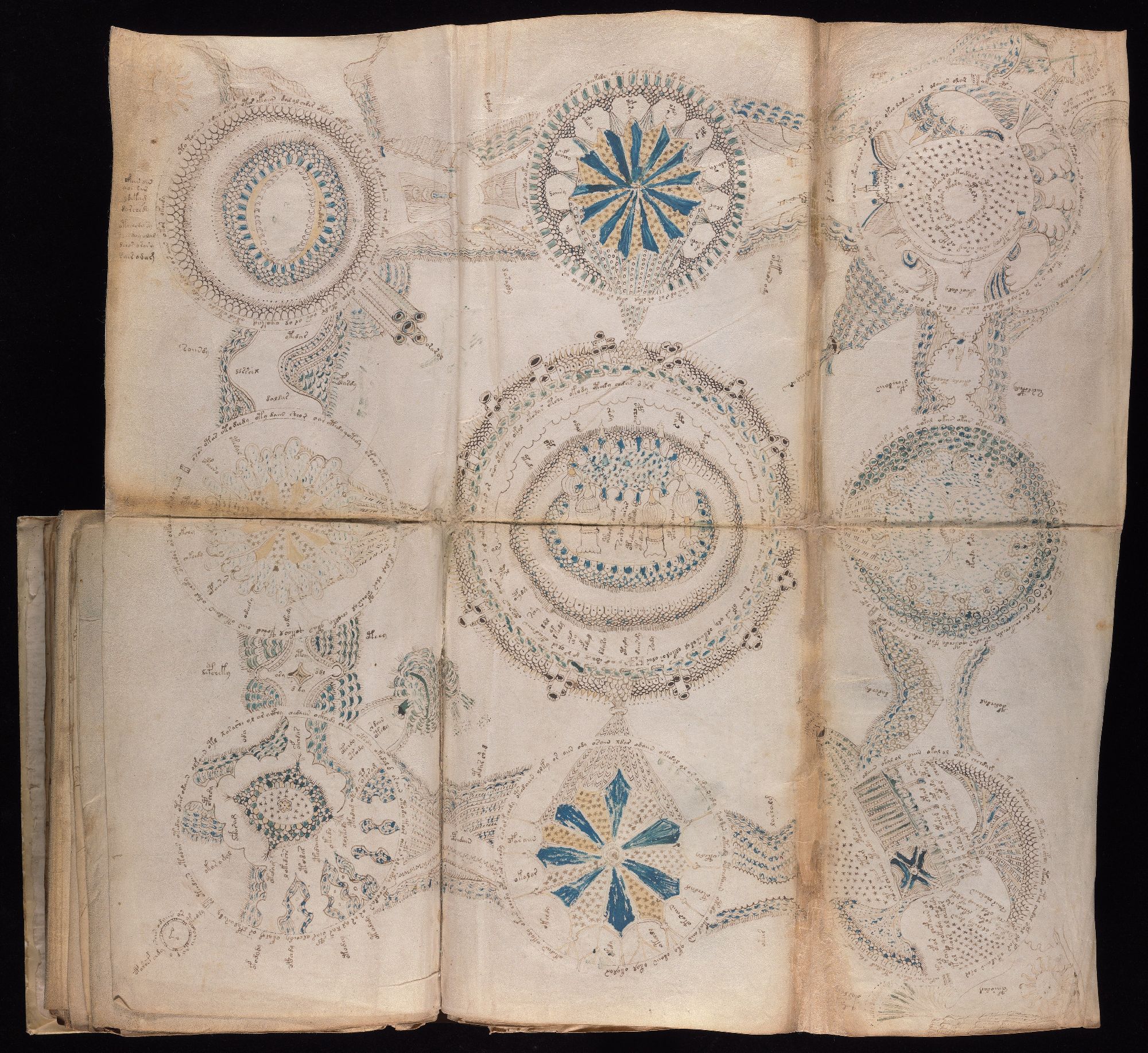
The foldout joins nine roundels with drawn passages and structures. Read its catalogued image in the public Coviewer.
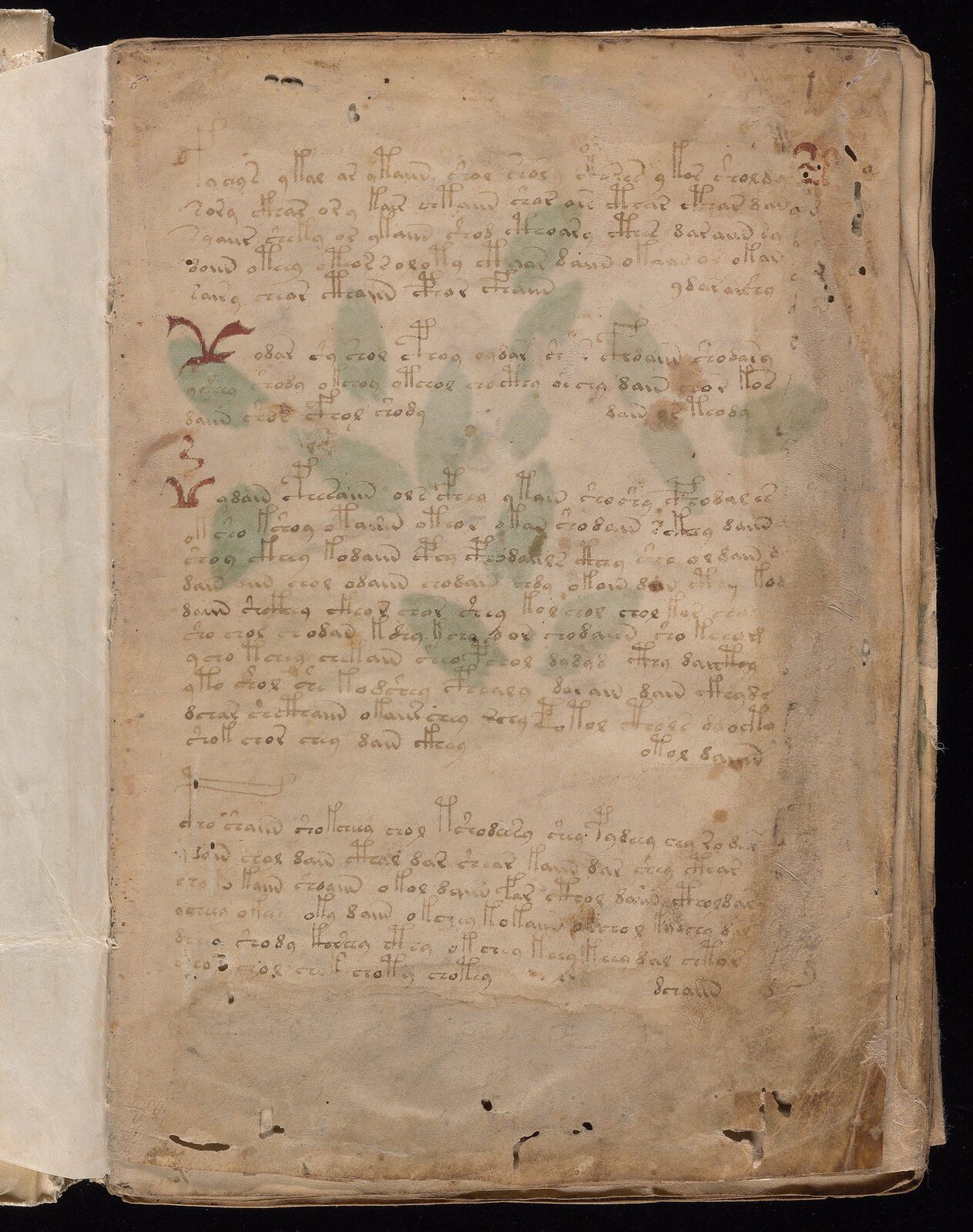
Drawings of plant parts arranged beside container-like (“jar”) forms, with short labelled entries. The labelled entries are brief, set next to the drawn objects.
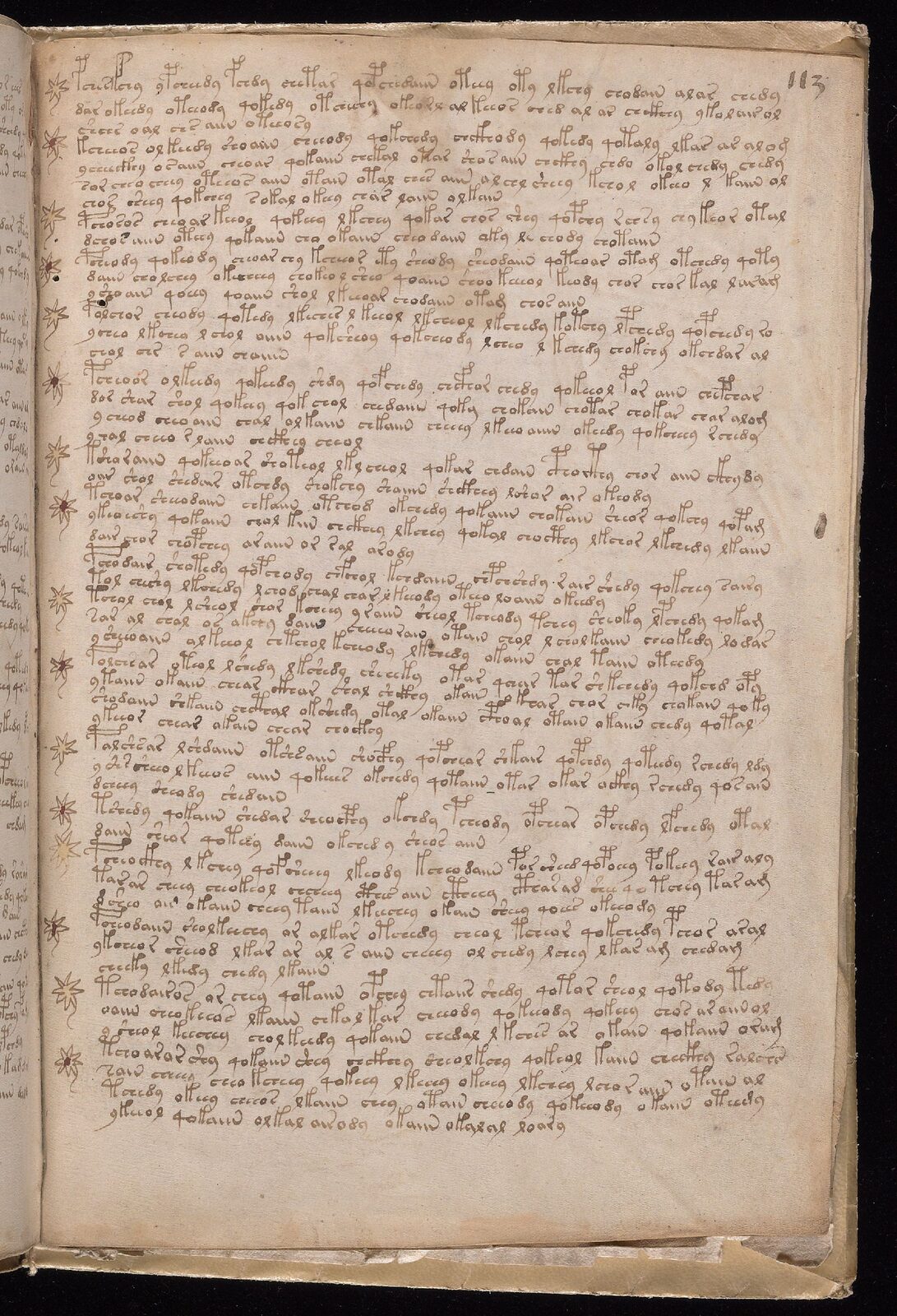
Densely written text pages with little or no illustration, marked by short paragraphs , many opened with a star or flower in the margin.
The largest single diagram in MS 408 spans two leaves that fold out together. It is built from nine roundels, rosettes, joined by drawn causeways and structures. The nine-medallion count is one instance of a nine-cardinality that recurs at specific points in this record’s comparator material; the record treats that recurrence as an observation, not as a reading of what the foldout depicts.
A May 2026 research note tested a South-German geographical interpretation of this foldout. That dated note is historical context. Current claim assessments are listed in the public research index.
The basis for all imaging-dependent observations in this record.
MS 408 has been fully digitized by the Beinecke Library, and high-resolution images are publicly available through Yale’s digital collections. The digitized manuscript is the basis for all imaging-dependent observations in this record.
Any uncertainty in page count, leaf order, or section boundary above reflects the physical state of the incomplete codex, missing leaves, fold-outs, and stubs, not a limitation of the digitization. The folio images shown on this site are reproduced from the library’s digitized manifest.
Public image access and the dated research index.
Read every folio of Beinecke MS 408 in the public Coviewer, one or two at a time, with zoom, pan and marks that travel in the link. No account, nothing stored in your browser.
Read manuscript images ›
Search 684 finding records, 649 manuscript records and 221 named figures in the dated public snapshot, with the Coviewer and the community claims beside them. The board provides finding titles and statuses; the full internal research record is separate.
Open the research board ›