Three hundred and twenty-six claims on the record, tier by tier
Every finding is a tier-labelled claim drawn from the live research substrate. A Confirmed finding may be stated as fact; a Supported finding is the substrate’s preferred reading with the test on the record; a Candidate finding is an open working hypothesis; Observed findings are noted patterns with no claim yet attached; Falsified findings are tested-and-broken and kept visible so the breaker is on the page. Tier is load-bearing: the language of the page is calibrated to the tier the substrate holds.
The findings shown on this page are illustrative representatives drawn from each tier — not the full register. Every finding here, and the 300+ others on the substrate, is fully addressable in the live research database, with sources, axes touched, related findings and edit history.
Each tier-card opens directly to its substrate listing. Each individual finding opens to its own substrate record — with the sources cited, the related findings linked, and the falsifier test (where one exists) on the page. It is not a static publication of results. The register is the surface of an active database: findings move tier, get re-described, or get retired as evidence accumulates.
The substrate · read-only early access
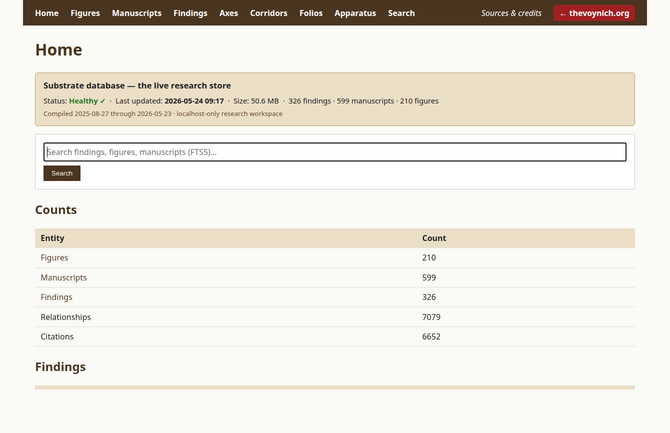
Behind this page sits the lab’s substrate database — SQLite with full-text search (FTS5), every finding, manuscript, figure and citation rowed and indexed, every relationship and axis-link traversable. The screenshot below is the substrate’s own homepage: status, counts, and the search bar that ranges across all 326 findings, 599 manuscripts, 210 figures and 6,652 citations. The substrate is a live store; counts grow as work continues.
What read-only early access carries
Why it’s gated — and how to walk it
“The point was to get people past the graveyard.”
— Ed Honeycutt, on what this work is for.
The substrate is currently a localhost-only research workspace. Read-only early access is opening on an invite basis, not because it’s precious, but because the work is to get serious researchers past the decoder-theatre graveyard and into something they can actually use — primary sources, tier-disclosed claims, falsifiers on the page. The gate is purpose, not price.
If you have a real research question and the substrate can move it forward, we want you walking it. Write to hello@honeycuttailabs.com with what you’re working on — the question tells us which surface (search, finding-record deep-link, manuscript catalogue, corridor map) to walk you through first.